The “Heavy Hitters”: AI Tools That Actually Work
Araba, the AI landscape of 2026 is no longer about the “magic” of a bot talking back to you; it’s about mechanical integration. The hype has died down, and we are left with tools that either save hours of manual labor or simply clutter your browser tabs.
To cut through the noise, here is the 2026 breakdown of what actually moves the needle for professionals and what is just “AI theater.”
The “Heavy Hitters”: AI Tools That Actually Work
In 2026, the most logical tools are those that operate as autonomous agents rather than just chat interfaces.
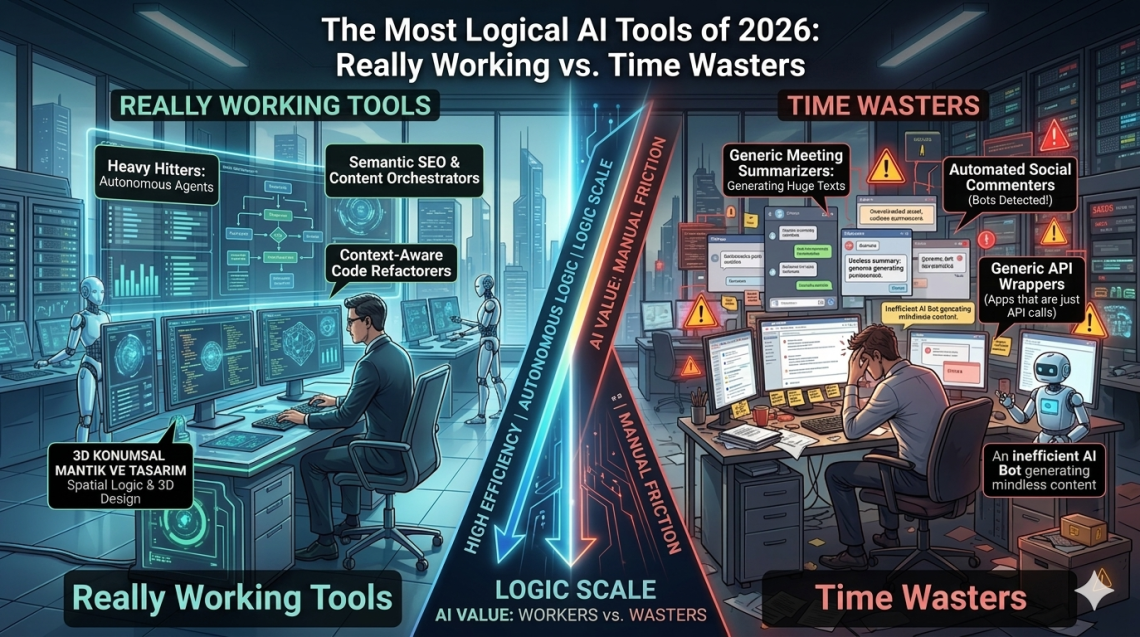
1. Semantic SEO & Content Orchestrators
The days of “one-click blog generators” are over because search engines now penalize generic AI prose instantly.
- The Logic: Tools that analyze User Intent Gaps rather than just keywords. They look at what competitors haven’t said and suggest data-driven sections to include.
- Why it works: It focuses on high-E-E-A-T (Experience, Expertise, Authoritativeness, and Trustworthiness) content, which is the only way to rank in 2026.
2. Autonomous Code Refactorers
For developers, the win isn’t “writing code” (LLMs have done that for years); it’s context-aware refactoring.
- The Logic: AI agents that live in your repository, understand your entire architecture, and automatically suggest performance optimizations or security patches without breaking dependencies.
- Why it works: It reduces technical debt while you sleep, allowing you to focus on logic and architecture rather than syntax debugging.
3. Spatial & Visual Logic Engines
We’ve moved past “generating a pretty picture.” The 2026 winners are AI tools that understand 3D constraints.
- The Logic: If you’re planning a garden layout or an interior remodel, these tools don’t just “draw” it—they calculate sunlight angles, soil compatibility, and structural load.
- Why it works: It bridges the gap between a “cool image” and a “workable blueprint.”
The “Time Wasters”: What to Delete in 2026
“Just because it has a ‘Chat’ button doesn’t mean it has a ‘Solution’ button.”
The Tool Type Why it’s a Time Waster Generic Meeting Summarizers They generate 5-page transcripts that no one reads. Unless it extracts specific action items into your Jira/Trello, it’s just noise. AI “Wrapper” Apps 90% of apps that charge $20/month are just basic API calls you can do yourself. If it doesn’t have a unique dataset, it’s a waste of money. Automated Social Commenters Engagement bots are now easily detected. They damage your brand authority more than they help “the algorithm.”
The “Logic” Checklist for 2026
Before adding a new AI tool to your workflow, ask these three questions:
- Does it have “Memory”? If it forgets the context of your project every time you start a new session, it’s a toy, not a tool.
- Does it integrate? If you have to “copy-paste” between the AI and your CMS or IDE, the friction is killing your productivity.
- Is it verifiable? Does the tool provide sources or a “logic chain” for its decisions? In 2026, blind trust in AI output is a professional liability.
Final Verdict
The most “logical” AI isn’t the one that writes for you; it’s the one that thinks with you. Focus on tools that handle the “grunt work” of data analysis and structural organization so you can spend your time on the creative “human” decisions.
Since you are managing multiple projects from a home-based office, which part of your current workflow feels like it’s still stuck in “manual mode”?