Sports Gadgets People Actually Use: Moving Beyond the Hype
Every year, millions of people buy the “next big thing” in fitness technology, hoping it will be the magic spark for their routine. Fast forward a month: the stationary bike is a clothes rack, and the smart ring is lost in a drawer. To avoid this fate, consider investing in practical sports gadgets that enhance your workout experience.
In 2026, the trend has shifted toward functional minimalism. People are abandoning flashy, high-maintenance gear in favor of tools that solve specific problems. Here are the gadgets that have proven their worth by actually being used day after day.
In 2026, the trend has shifted toward functional minimalism. People are abandoning flashy, high-maintenance gear in favor of tools that solve specific problems. Here are the gadgets that have proven their worth by actually being used day after day, including the latest practical sports gadgets.
Exploring Practical Sports Gadgets
1. The Running Belt: The Invisible Essential
Trying to run with a phone bouncing in your pocket or keys jingling in your hand is a “friction factor” that kills motivation.
- Why It Sticks: It’s simple. It requires no charging. It solves one problem perfectly: “Where do I put my stuff?”
- The 2026 Upgrade: We’ve moved past bulky fanny packs. The modern “wrap” style belts are seamless, sweat-proof, and sit so flush against the skin you forget you’re wearing them.
- Verdict: If you move, you need one. It’s the ultimate low-tech gadget.
2. The Recovery Gun (Massage Gun): Your On-Call Physical Therapist
What started as a tool for pro athletes has become a staple for everyone from marathon runners to office workers.
- Why It Sticks: The ROI is physical. It tangibly reduces muscle soreness (DOMS) and improves blood flow, meaning you can get back to your next workout faster.
- Beyond the Gym: It’s equally useful for relieving neck and shoulder tension caused by long hours at a desk, making it a “lifestyle” tool rather than just a “gym” tool.
3. The Smart Jump Rope: Gamifying Cardio
Jumping rope is one of the most efficient ways to burn calories, but let’s be honest: counting reps is boring, and we all lose track.
- Why It Sticks: Digital counters and app syncing turn a monotonous task into a game. Setting a goal for 1,000 jumps and seeing the data in real-time makes you more likely to finish the set.
- The “Ropeless” Innovation: For apartment dwellers, 2026 has seen a surge in “ropless” smart ropes—weighted handles that mimic the centrifugal force of a rope without hitting your ceiling or tripping you up.
Budget vs. Premium: Where Should You Spend Your Money?
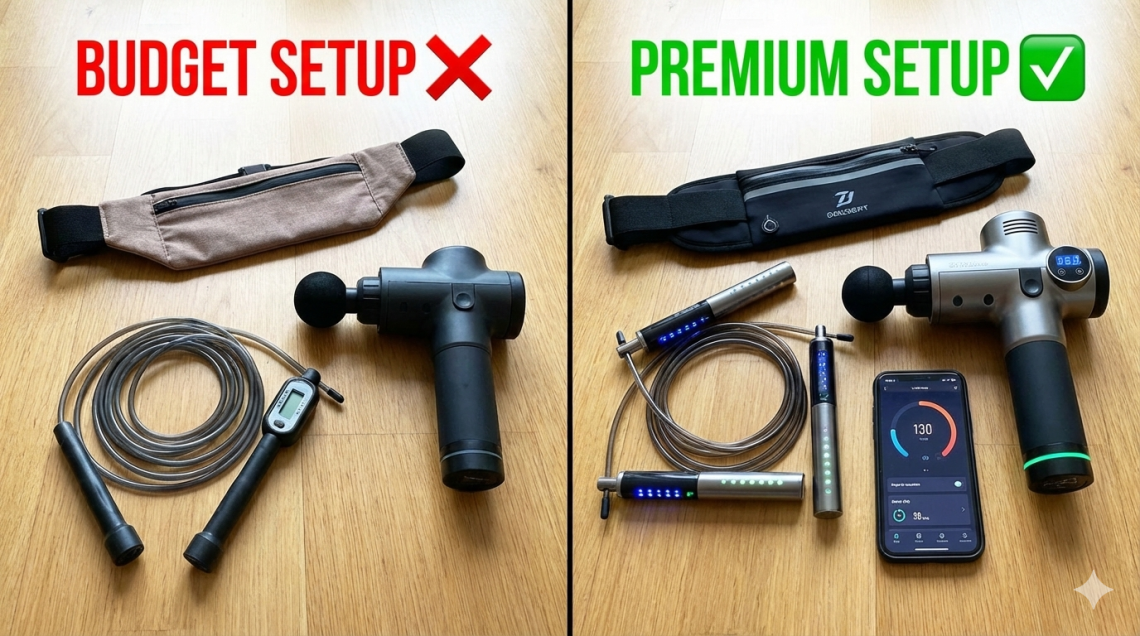
In the sports world, “expensive” doesn’t always mean “better.” Here is where you should save and where you should splurge:
| Gear | Go Budget? | Why? |
| Running Belt | YES | A basic high-quality fabric and a sturdy zipper get the job done. Paying 5x more for a logo adds zero performance. |
| Recovery Gun | NO | Cheap models lack “stall force” (the motor stops if you press hard) and have terrible battery life. Invest in a mid-to-high-tier brand for actual percussive therapy. |
| Smart Jump Rope | OPTIONAL | If you just want it to count, go budget. If you want integrated coaching and detailed heat maps of your cardio sessions, go premium. |
The “Dust Test”: Before You Buy
Before adding a sports gadget to your cart, ask yourself: “Does this reduce the effort of working out, or does it add a new chore to my routine?”
If a gadget requires a 2-hour charge, a software update, and a specific proprietary clothing item just to function, it will be covered in dust within two weeks. The best sports tech is the kind that you can grab and use in under 10 seconds.
FAQ
Can I use a recovery gun every day? Yes, but avoid using it on the same muscle group for more than 2 minutes at a time, and never use it directly on bone or joints.
Will a running belt bounce while I sprint? Not if you get the right size. Look for “compression-fit” belts rather than adjustable buckled ones if you want zero bounce.
Is a smart jump rope better than a normal one? The workout is the same, but the accountability is higher. If seeing your stats helps you stay consistent, it’s worth the extra $20.