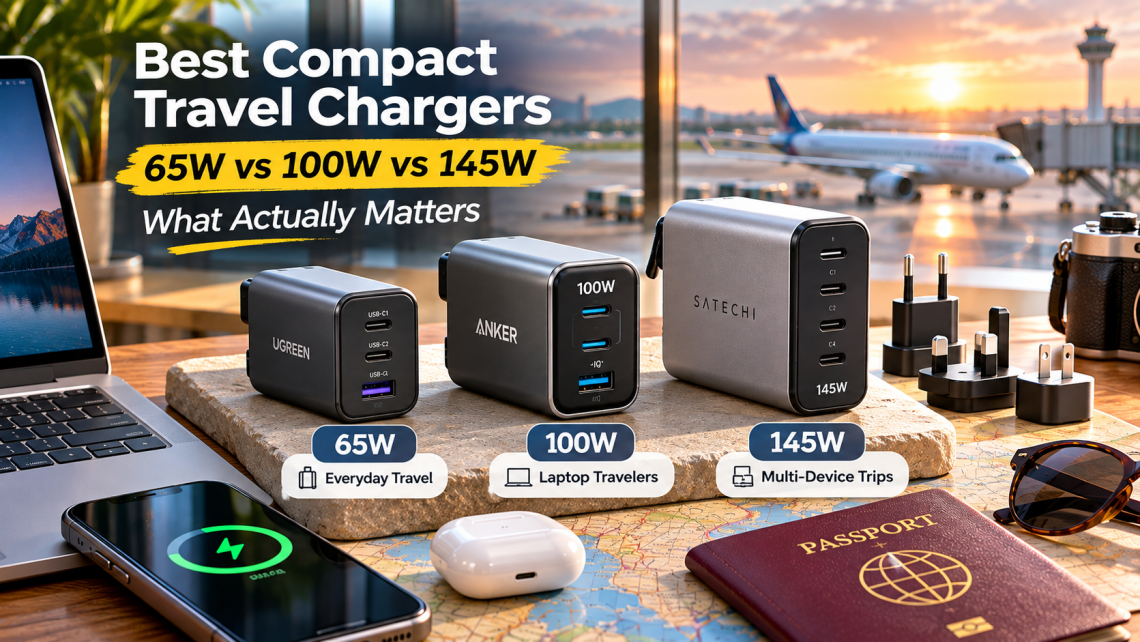
Best Compact Travel Chargers for Multi-Device Trips: What Actually Matters (2026)
One charger for your laptop, phone, tablet, and travel accessories? Here’s how to choose the right compact travel charger without paying for power you won’t use.
Your hotel room has one convenient power outlet.
Your laptop is running low. Your phone needs charging. Your tablet is almost empty, and you still have tomorrow’s itinerary to plan.
You brought a multi-port charger to make traveling easier.
But when you plug everything in, your laptop suddenly charges more slowly.
What happened?
The answer usually isn’t a defective charger. It’s power distribution—one of the most overlooked details when shopping for compact travel chargers.
A charger advertised as 100W doesn’t necessarily deliver 100W to your laptop while simultaneously charging two other devices.
And a charger with four USB ports isn’t automatically better than one with three.
For this guide, we’re comparing four real charging options, examining their published specifications, and explaining what matters when you’re traveling with multiple devices.
Our goal is simple: help you buy the right charger for your actual travel setup.
Quick Comparison: Best Compact Travel Chargers
| Charger | Maximum Advertised Output | Ports | Best For |
|---|---|---|---|
| UGREEN Nexode 65W 3-Port GaN | 65W | 2 USB-C + 1 USB-A | Everyday travelers |
| Anker Prime 100W 3-Port GaN | 100W | 2 USB-C + 1 USB-A | Laptop and phone users |
| Satechi 145W USB-C 4-Port GaN Travel Charger | 145W | 4 USB-C | Multi-device international travel |
| UGREEN 65W International Travel Charger (90409) | 65W | 2 USB-C + 1 USB-A | Travelers needing interchangeable plugs |
Important: These wattage figures describe manufacturer-rated maximum output, not guaranteed power to every connected device. Actual charging depends on the charger, cable, device, and number of ports in use.
1. UGREEN Nexode 65W 3-Port GaN Charger — Best for Everyday Travel

Best for: Travelers carrying a phone, tablet, and lightweight USB-C laptop.
For many people, 65W is the sweet spot between portability and usefulness.
The UGREEN Nexode 65W combines two USB-C ports and one USB-A port in a compact design.
According to UGREEN’s published specifications, either USB-C port can provide up to 65W when used individually. The charger supports USB Power Delivery and PPS charging protocols, with universal 100–240V AC input.
Why it makes sense
Imagine a five-day trip to London.
You’re bringing a lightweight laptop for occasional work, a smartphone for navigation, and wireless earbuds.
You probably don’t need an oversized 140W charging station.
A compact 65W charger may be sufficient, provided your laptop’s charging requirements are compatible.
What we like
- Two USB-C ports plus a USB-A connection
- USB Power Delivery and PPS support
- Compact form factor
- Suitable for many everyday device combinations
What to consider
The maximum 65W rating doesn’t mean every device receives that much power simultaneously.
Also, some laptops need more power for demanding workloads. A 65W charger may charge them more slowly or fail to maintain battery level during intensive use.
Traveler Talk: Many travelers debate whether a 65W charger is enough for a laptop. The practical answer depends less on the laptop’s screen size and more on its actual power requirements and what else you’re charging.
Shop&World Tip: Check the wattage printed on your original laptop charger before choosing a replacement.
2. Anker Prime 100W 3-Port GaN Charger — Best for Laptop Travelers

Best for: Travelers who want one compact charger for a laptop, phone, and another accessory.
A 100W charger offers more headroom than a typical 65W model.
That additional capacity can be useful when you’re traveling with a laptop that supports higher-power USB-C charging.
The Anker Prime 100W model A2688 includes two USB-C ports and one USB-A port.
Its published specifications list up to 100W output with one port in use, up to 100W across two ports, and a maximum of 89W with all three ports active.
Why the distinction matters
Let’s say your laptop can accept 100W over USB-C.
When it’s the only connected device, the charger may be able to provide its full rated output.
But connect a phone and another device, and the available power is shared.
That’s normal behavior.
It simply means the advertised wattage isn’t a promise that every connected device charges at maximum speed.
What we like
- Higher power capacity for compatible laptops
- Three charging ports
- Compact GaN design
- Wide-range AC input for international use
What to consider
Anker recommends using the upper USB-C port for laptops when both USB-C ports are occupied.
For high-power charging, you’ll also need an appropriately rated USB-C cable.
And because this is primarily a wall charger, you may still need a compatible plug adapter when traveling between countries.
Traveler Talk: A common frustration with multi-port chargers is seeing charging speeds change after plugging in a second device. This isn’t necessarily a product defect; many chargers renegotiate power when the connected device combination changes.
Shop&World Tip: If you regularly charge a laptop and phone together, compare dual-port output specifications before comparing the headline wattage.
3. Satechi 145W USB-C 4-Port GaN Travel Charger — Best for International Multi-Device Trips
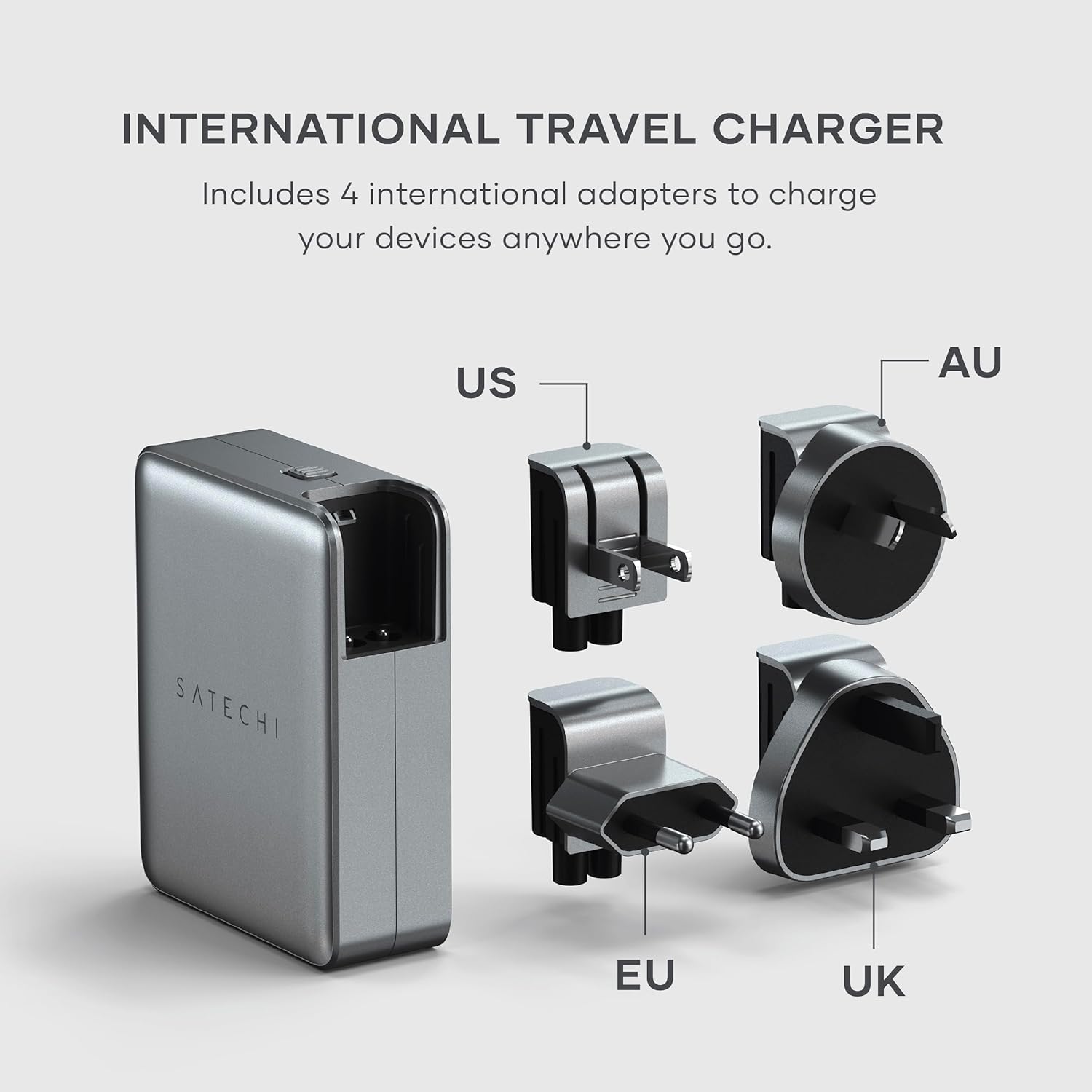
Best for: Travelers carrying multiple USB-C devices who also need interchangeable international plugs.
The Satechi 145W Travel Charger takes a different approach.
Instead of offering a mixture of USB-C and USB-A connections, it provides four USB-C ports.
It also includes interchangeable plug adapters for the US, EU, UK, and AU regions.
That’s especially useful for travelers moving between destinations with different outlet standards.
What makes it different?
Satechi publishes detailed power distribution information.
When a single compatible device is connected to one of the first two USB-C ports, that port can deliver up to 140W.
With two devices connected to the first two ports, the specified distribution becomes:
65W + 65W
With all four ports occupied, the published distribution is:
65W + 30W + 25W + 20W
That’s much more useful information than the 145W headline alone.
A real travel scenario
Imagine a work trip from Singapore to London.
You’re traveling with a USB-C laptop, smartphone, tablet, and another rechargeable device.
At the hotel, you want to charge all four without carrying separate wall adapters.
The Satechi can handle four USB-C connections, but you should connect the highest-power device to the recommended port and understand that charging speeds depend on how many devices are attached.
What we like
- Four USB-C charging ports
- Interchangeable international plug adapters
- Detailed published power distribution
- High output for compatible devices
- Wide-range 100–240V input
What to consider
This is more charger than many casual travelers need.
It also has no USB-A port, so older accessories may require different cables.
Charging cables aren’t included, and obtaining the highest supported charging speeds requires compatible devices and cables.
Traveler Talk: Multi-country travelers often debate whether to carry a universal adapter plus a separate charger or buy a charger with interchangeable plug heads. An integrated travel charging solution can reduce clutter, but only if its port selection matches your devices.
Shop&World Tip: This is our most interesting option for a multi-country, multi-device trip—not necessarily the best value for someone charging only a phone.
4. UGREEN 65W International Travel Charger (90409) — Best for Plug Compatibility
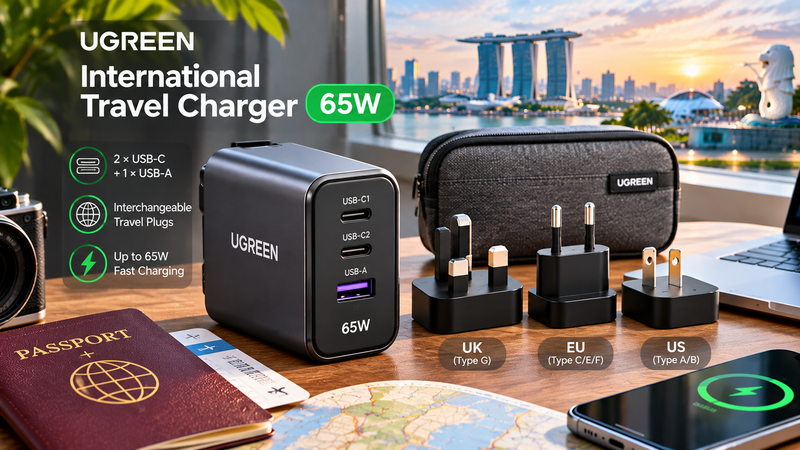
Best for: Travelers visiting countries with different socket standards who don’t need very high charging power.
This UGREEN model is different from the standard Nexode 65W wall charger.
It is specifically designed as an international travel charger with interchangeable plug attachments.
The published product information lists EU, UK, and US plug accessories, two USB-C ports, one USB-A port, and up to 65W maximum output.
Why it deserves consideration
A compact charger is only convenient if you can actually connect it to the wall.
A traveler moving between Singapore, the United Kingdom, and continental Europe may encounter different socket types.
Having the appropriate interchangeable plugs can make the charging setup easier to manage.
What we lik
- Interchangeable EU, UK, and US plugs
- Three charging ports
- 65W maximum output
- Travel-oriented design
- Carrying pouch included in the listed package
What to consider
Check that the included plug heads match every destination on your itinerary.
Also, don’t confuse plug compatibility with voltage conversion. A travel charger should be used only within its specified electrical input range.
Traveler Talk: Travelers sometimes buy a universal plug adapter even though their charger already comes with interchangeable regional plugs. Checking the complete product package before buying can prevent duplicate accessories.
Shop&World Tip: This option makes more sense for international travel than buying a charger purely because it has the smallest dimensions.
65W vs. 100W vs. 145W: How Much Charging Power Do You Really Need?
Higher wattage doesn’t automatically mean a better travel charger.
It means the charger has a higher potential power output.
Whether that matters depends on your devices.
| Travel Setup | Practical Starting Point | Why |
|---|---|---|
| Smartphone + earbuds | 30–45W | Usually sufficient for a simple setup |
| Smartphone + tablet | 45–65W | More flexibility across devices |
| Lightweight USB-C laptop + phone | 65–100W | Depends on laptop requirements |
| Higher-power USB-C laptop + phone | 100W or higher | More power headroom |
| Laptop + tablet + two phones | 100–145W+ | Port allocation becomes important |
These are shopping guidelines, not universal device requirements.
For example, a laptop supplied with a 100W charger may work with a lower-powered charger, but performance and charging behavior can vary.
Before buying, check your devices’ official charging specifications.
The Most Important Feature: Power Distribution
This is the part of the buying process that deserves the most attention.
Let’s compare two verified examples.
Anker Prime 100W
- One port active: up to 100W
- Two ports active: up to 100W combined
- Three ports active: up to 89W combined
Satechi 145W
- One compatible high-power port active: up to 140W
- Two primary USB-C ports active: 65W + 65W
- Four ports active: 65W + 30W + 25W + 20W
The difference isn’t simply 100W versus 145W.
It’s how the available power is allocated.
What to remember: A multi-port charger is a shared power supply. Check the manufacturer’s port-combination table before purchasing.
USB-C PD, PPS, and GaN Explained Without the Jargon
USB-C Power Delivery (PD)
USB Power Delivery is a charging standard that allows compatible devices and chargers to negotiate supported power levels.
The charger doesn’t simply force its maximum wattage into every device.
The connected equipment determines a compatible charging arrangement.
PPS: Programmable Power Supply
PPS allows compatible chargers to adjust voltage and current within supported ranges.
This can be useful for certain smartphones and other devices that support PPS-based fast charging.
But PPS support alone doesn’t guarantee the fastest charging mode for every phone.
Check the exact protocol requirements of your device.
GaN: Gallium Nitride
GaN is a semiconductor technology used in many modern chargers.
It can enable compact, efficient power-conversion designs.
However, a GaN label doesn’t automatically prove that a charger is safer, cooler, or faster than every alternative.
Those outcomes depend on the complete product design, thermal management, and electrical performance.
Shop&World Tip: Prioritize verified specifications and appropriate safety documentation over marketing terms.
International Plug Compatibility: What Travelers Need to Know
Different countries use different electrical plug systems.
That’s why a charger that works perfectly at home may not fit a hotel outlet abroad.
| Destination | Common Plug Types | What to Check |
|---|---|---|
| Singapore | Type G | UK-style plug compatibility |
| United Kingdom | Type G | UK-style plug compatibility |
| United States | Types A and B | US plug attachment |
| Japan | Types A and B | Plug shape and electrical input |
| France | Types C and E | European compatibility |
| Germany | Types C and F | European compatibility |
| Australia | Type I | Australian plug attachment |
These are common standards; individual buildings and accommodations may vary.
One critical distinction
A travel plug adapter is not necessarily a voltage converter.
Many modern USB chargers accept 100–240V AC input, making them suitable for use across different electrical systems with the correct plug connection.
But you must check the actual charger’s input label.
This is especially important when traveling with non-USB appliances such as hair dryers and styling tools.
Don’t Forget the USB-C Cable
A powerful charger won’t deliver its full potential if the cable isn’t suitable.
For higher-power USB-C charging, choose a cable with the required power rating and proper electronic identification where applicable.
For example, 100W-class charging requires an appropriate 5A-rated cable under the relevant USB-C specifications.
For USB PD 3.1 Extended Power Range charging above 100W, an appropriately rated EPR cable is required.
Also remember that charging power and data transfer speed are separate cable specifications.
You don’t necessarily need an expensive high-speed data cable simply to charge a laptop.
Shop&World Tip: Before buying a new charger, inspect the cables you already own. A compatible cable may be the missing piece.
Charger Size, Heat, and Safety: What Actually Matters?
Compact chargers are convenient, especially when traveling with only a carry-on.
But smaller isn’t always better.
A charger that blocks adjacent outlets or feels unstable in a loose wall socket can become frustrating.
Consider the following before buying:
- Does the charger fit securely in the outlet?
- Are the ports accessible when all cables are connected?
- Is the input voltage suitable for your destination?
- Does the manufacturer publish electrical and safety information?
- Does the charger provide enough output for your laptop?
- Can it operate within the temperatures and conditions specified by its manufacturer?
Chargers can become warm during normal operation.
However, unusual smells, visible damage, intermittent connections, or excessive heat are reasons to stop using a device and investigate.
Never cover a charger with clothing or bedding while it is operating.
Which Compact Travel Charger Would We Choose?
The right answer depends on what you’re bringing.
For a simple vacation: UGREEN Nexode 65W is a sensible starting point.
For a laptop-focused trip: Anker Prime 100W provides additional charging headroom.
For multiple USB-C devices across several countries: Satechi 145W is the most complete option in this comparison.
For convenient regional plug changes without needing 100W+: UGREEN International Travel Charger 90409 deserves consideration.
We wouldn’t buy the highest-wattage charger just because it looks more impressive.
We’d buy the smallest, most practical charger that reliably supports our actual devices.
A Quick Pre-Purchase Checklist
Before ordering a travel charger, confirm:
- My laptop’s required charging wattage
- How many devices I need to charge simultaneously
- Whether I need USB-A as well as USB-C
- The charger’s power distribution across multiple ports
- USB PD and PPS compatibility where needed
- The voltage range printed on the charger
- Plug compatibility for my destination
- Suitable USB-C cables
- Manufacturer safety documentation and warranty
Final Verdict: Buy for Your Devices, Not the Wattage Number
A compact travel charger can genuinely make international travel easier.
It can replace several bulky adapters, simplify your hotel charging setup, and help you stay organized between destinations.
But the smartest purchase isn’t always the charger with the highest wattage or the most ports.
It’s the one that matches your laptop, phone, cables, and destination.
For many travelers, a 65W charger is enough.
For laptop-heavy travel, 100W can offer useful flexibility.
And for someone carrying four USB-C devices across multiple countries, a well-designed 145W travel charger may justify the extra complexity.
The best compact travel charger isn’t the one that promises the most power. It’s the one that delivers the right power where you actually need it.
For a broader packing guide, explore our International Travel Essentials article. And if you’re preparing for a long flight, our Best Travel Gadgets for Long Flights guide covers other useful travel accessories.
Frequently Asked Questions
Is a 65W charger enough for a laptop and phone?
It may be, depending on the laptop’s power requirements and the charger’s dual-port distribution. Check the specifications for your exact devices and charger.
Is a 100W charger better than a 65W charger for travel?
A 100W charger offers more potential power, which can be useful for compatible laptops and multiple devices. But a 65W charger may be more than adequate for a lighter travel setup.
Can I charge three devices at once with a GaN charger?
Yes, if the charger has at least three suitable ports and supports simultaneous charging. Power is shared according to the model’s port-allocation rules.
Does a GaN charger work internationally?
Many GaN chargers support 100–240V AC input, but not all have the same plug configuration. Check both voltage compatibility and outlet compatibility.
Do I need a special USB-C cable for 100W charging?
You need a cable rated for the required current and power. Higher-power USB-C charging may require electronically marked cables.
Is a universal travel charger the same as a power bank?
No. A travel wall charger uses an electrical outlet to power connected devices. A power bank stores energy in a battery and can charge devices without a wall outlet.
Is a 145W charger necessary for international travel?
Not for most travelers. It becomes more relevant when you regularly charge several devices, particularly laptops and tablets, and want one charging setup for multiple destinations.
Editorial disclosure: This comparison is based on publicly available manufacturer specifications and practical travel-use scenarios. Products were not independently laboratory-tested by Shop&World. Features and availability may vary by model and region.
International Travel Essentials: What to Pack Before Your Next Trip (2026 Guide)